
Guest Blog Post
via Jet Ice Research Chair Bulletin
Published with permission
Microplastics and rink ice-shaving waste
When ice is resurfaced, the focus is usually on what is left behind: a smooth, clean, playable sheet. The snow removed from the surface
is often treated as a routine by-product of rink maintenance. It is collected by the ice resurfacer, dumped into a melt pit or snow pile, and then forgotten.
But that snow is not just frozen water.
During normal rink use, the ice surface collects material from skates, sticks, pucks, boards, protective equipment, clothing, logos, coatings, dust, and the surrounding arena environment. Much of this material is too small to see during day-to-day operations. Once the ice resurfacer removes the top layer of the surface, these particles are concentrated in the ice shavings.
A new study from researchers in the Faculty of Science at Toronto Metropolitan University examined this overlooked waste stream
at the Mattamy Athletic Centre in Toronto, formerly Maple Leaf Gardens. The research looked at ice shavings collected after routine hockey activities and compared them with the source water used to make the ice. The goal was to determine whether rink operations were adding microplastics and plastic-associated chemicals to the ice surface before that material entered meltwater or wastewater systems.
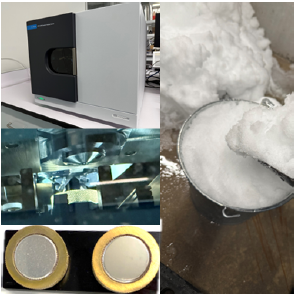 The results were clear: microplastics were found in every ice-shaving sample.
Across thirteen sampling events, melted ice shavings contained between 59 and 2,063 microplastic particles per 100 mL. Most of these particles were extremely small. They were not pieces an operator would notice in the snow pile, but they were present in measurable numbers.
When those concentrations are scaled up to rink operations, the numbers become easier to understand. A single resurfacing event at the sampled rink could contain roughly 0.06 to 1.9 million microplastic particles in the melted ice shavings. Over a full operating year, that could add up to hundreds of millions to several billion particles from one rink.
These numbers should not be treated as universal values for every arena. This was one rink, in one city, over one season. But the result is still important because it shows that resurfacer snow can be a pathway for small plastic particles leaving the ice surface.
This does not mean hockey is unusual in producing microplastics. Small plastic particles are associated with many everyday human
activities, from clothing and packaging to roads, buildings, sports equipment, and household products. The important point is that arenas are one of the few places where this material can be collected in a predictable way. Because the resurfacer gathers the top layer of ice and concentrates it in the snow pile, the rink industry has an opportunity to understand and manage this pathway before it becomes a larger concern, and to position itself as a leader in developing best practices for contaminant mitigation.
The study also found that the particles were made of several different types of plastic. Many were consistent with materials commonly found in arenas, including boards, protective equipment, textiles, packaging, and other synthetic materials used around the rink. This does not point to one single source. Instead, it suggests that normal rink activity can leave behind a mixture of small particles from many materials.
That is an important distinction. The message is not that one product, one player, or one maintenance practice is responsible. The more useful takeaway is that the ice surface acts like a collector. During use, it receives material from the game, the equipment, the building, and the maintenance process. When the resurfacer removes the top layer of ice, that material is collected in the snow pile.
The study also looked at plastic-associated chemicals. These are chemicals that can be used in or released from plastic products, coatings, rubber materials, textiles, and other synthetic materials. The key finding was that ice shavings contained higher levels
of some of these chemicals than the water used to make the ice. That means the material was likely being added during rink use
or from rink infrastructure, rather than simply coming in with the source water.
For rink operators, the practical point is straightforward: ice shavings should be treated as more than clean snow.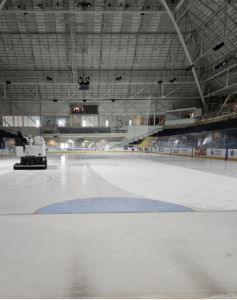
What happens next depends on how a facility handles its resurfacer waste. In some arenas, ice shavings are dumped into an indoor melt pit that drains to the sanitary sewer. In others, snow may be dumped outside, where it melts and can move toward storm drains, soils, lawns, or nearby surface waters. Those pathways are not the same. Outdoor dumping gives the facility much less control over where the meltwater and particles go.
This does not mean every rink needs an expensive treatment system tomorrow. This was an early study, and more work is needed across different facilities, sports, seasons, and snow-handling practices. But it does suggest that arenas should know where their snow goes and whether there are simple ways to reduce direct release to the outdoor environment.
A practical first step is simply asking a few questions. Does the resurfacer snow go to a melt pit, a sanitary sewer, a storm sewer, or an outdoor pile? Is the drainage pathway known? Are there screens, traps, or settling areas in place? If snow is dumped outside, is it melting near a storm drain or nearby waterway?
The main message is not that rinks are uniquely polluting or that operators have done something wrong. Until now, this waste stream has simply been overlooked. Ice shavings look like snow, and because they melt into water, it is easy to assume they are harmless.
This study shows that assumption deserves a closer look.
For the ice industry, that creates an opportunity. Arenas are controlled environments. Operators already manage water treatment, resurfacing, ice thickness, temperature, humidity, boards, paint, logos, and maintenance schedules. That means rinks may be well
positioned to measure and reduce this pathway in practical ways.
For now, the conclusion is simple: the snow pile deserves more attention.
Ice shavings are not just a maintenance by-product. They are a concentrated record of what happened on the ice surface. Understanding
what is in that snow is an important next step toward more sustainable rink operations.
Reference
Li, Y., Hutchins, R.H.S., Oswald, C., Impellizzeri, S. and S¨uhring, R. Microplastics and PMT plastic-associated chemicals as co-contaminants in ice shaving waste from an urban ice rink. Environmental Science: Processes & Impacts. 2026. https://doi.org/10.1039/d5em01017a
The Jet Ice Research Chair in Sustainable Materials Chemistry at Toronto Metropolitan University was established in 2022 to advance research in smart and green materials chemistry for ice-making applications. This partnership combines TMU’s research excellence with industry leadership from Jet Ice, a global leader in ice-making technology, to explore sustainable paint formulations and water quality enhancement techniques, driving innovation that supports environmental sustainability and performance improvements in ice-making systems. To learn more about this partnership and to read previous findings visit: https://www.torontomu.ca/science/research/research-chairs/jet-ice-chair/
Jet Ice is a corporate partner of Recreation PEI.